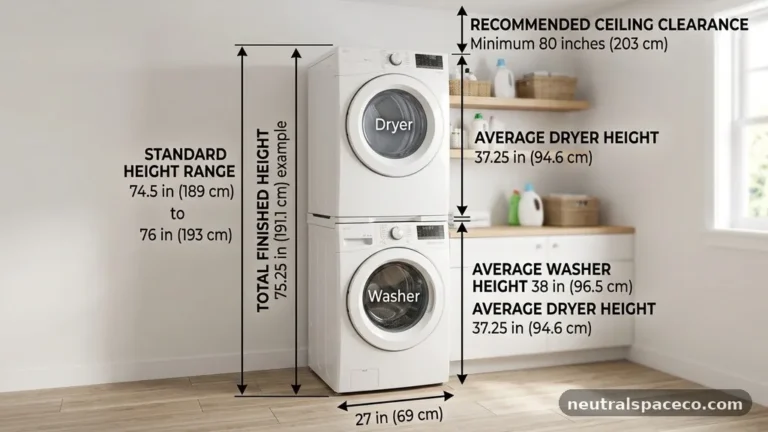
30-Inch vs 33-Inch Deep Laundry Closets: Will Modern Front Loaders Fit?
Choosing between 30-inch vs 33-inch deep laundry closets often determines whether your dream appliance setup will actually function in your home. Many homeowners assume modern machines follow a universal size, but the reality is that a few inches of depth can be the difference between a functional workspace and a closet door that refuses to close.
When weighing 30-inch vs 33-inch deep laundry closets, you must account for the machine chassis, the rear venting, and the necessary clearance for water hoses. This article provides the precise measurements and installation requirements needed to ensure your new washer and dryer fit perfectly without compromise.
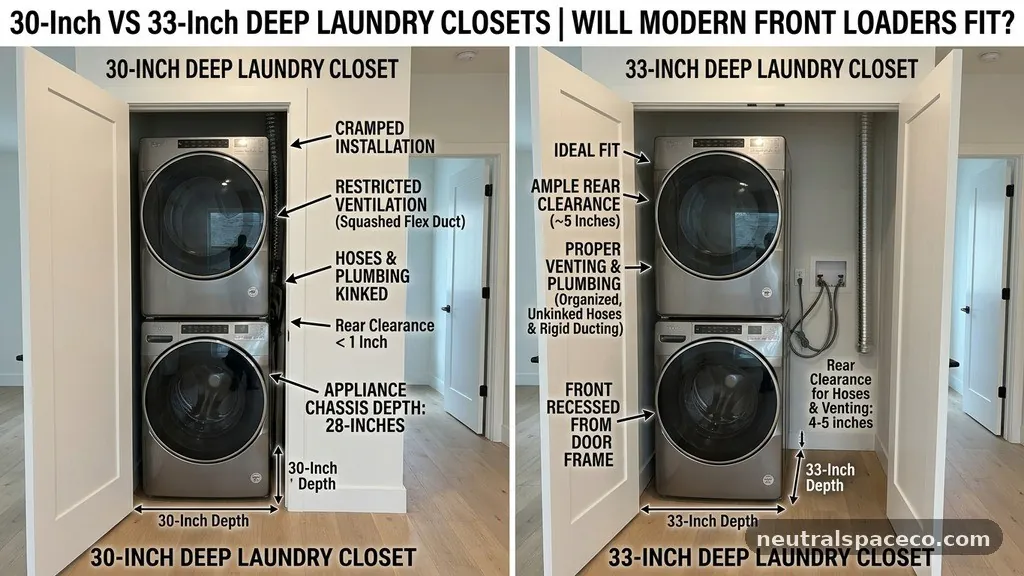
The short answer is that 30-inch deep closets are often too tight for modern full-sized front loaders, while 33-inch deep closets provide the necessary breathing room. If your closet is exactly 30 inches deep, you will likely struggle to close the door once you account for the power cord, the dryer vent, and the water supply lines.
Most high-capacity front-load washers and dryers measure between 30 and 34 inches in depth, not including the protruding knobs or the space required for hoses. A 33-inch depth provides the bare minimum required for a standard installation, whereas a 30-inch depth usually necessitates choosing compact or “apartment-sized” units.
Understanding Appliance Chassis Depth
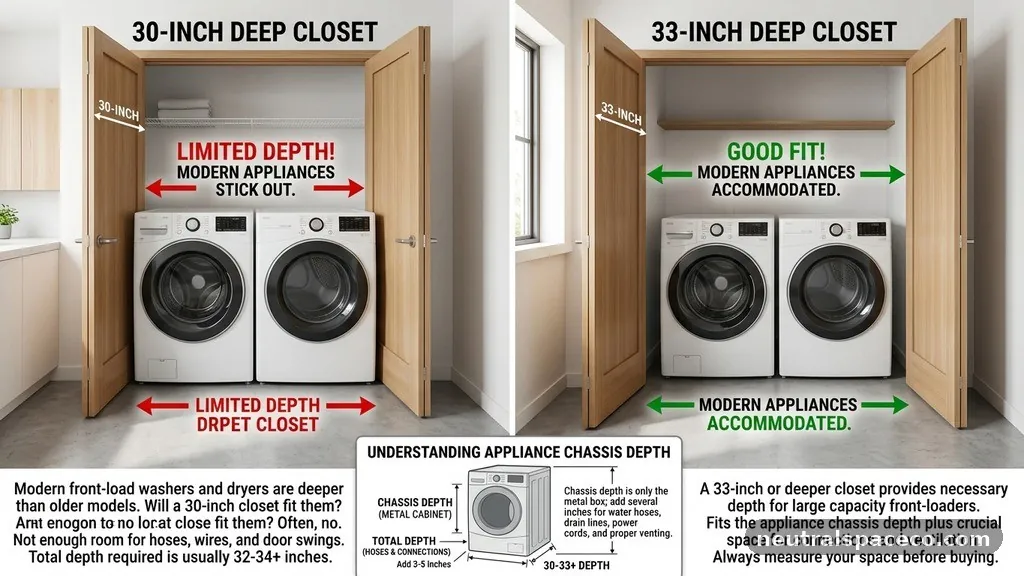
When you look at manufacturer specifications, the “depth” listed often refers to the cabinet size alone. This number does not include the depth of the door, the control panel, or the protrusions on the back of the machine. A machine listed as 30 inches deep might actually measure 32 or 33 inches when you factor in the physical footprint.
You must always check the “depth with door open” and “depth with hoses connected” specifications. If a manufacturer states a depth of 31 inches, you should assume it will require at least 34 inches of total closet depth to accommodate the connections. Failing to account for these extra two or three inches is the most common reason people find their new appliances won’t fit.
The Role of Rear Venting and Hoses
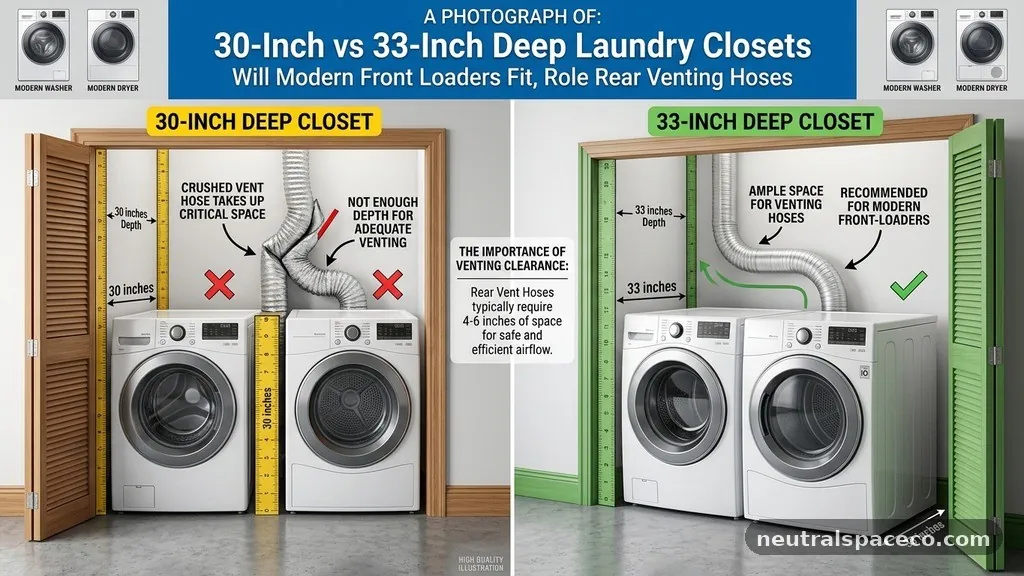
The rear of a laundry appliance is a high-traffic zone for plumbing and ventilation. Dryer vents, in particular, are rigid or semi-rigid pipes that require a specific turning radius behind the machine. If you push the dryer too close to the back wall, you risk kinking the vent, which creates a significant fire hazard and reduces the efficiency of your airflow.
Water hoses for washers also require space to bend without crimping. If the hoses are forced into a sharp 90-degree angle against the wall, they are prone to leaks or restricted water flow. A 33-inch deep closet allows enough space for these essential components to sit comfortably without being crushed against the drywall.
Why 30-Inch Closets Are Often Problematic
A 30-inch depth is a legacy standard that was common in older homes built before the era of high-capacity, deep-drum front loaders. Many older, top-load washers were shorter in depth, allowing them to fit into these shallower spaces with room to spare. Modern front loaders are engineered for larger load capacities, which inherently requires a deeper drum and a bulkier cabinet.
If you are stuck with a 30-inch closet, you are effectively limited to specific product categories. You will need to search for “compact” or “stacked” units specifically designed for tight spaces. These machines often have lower cubic-foot capacities but are the only way to avoid major renovations to your closet depth.
The Advantage of 33-Inch Depth
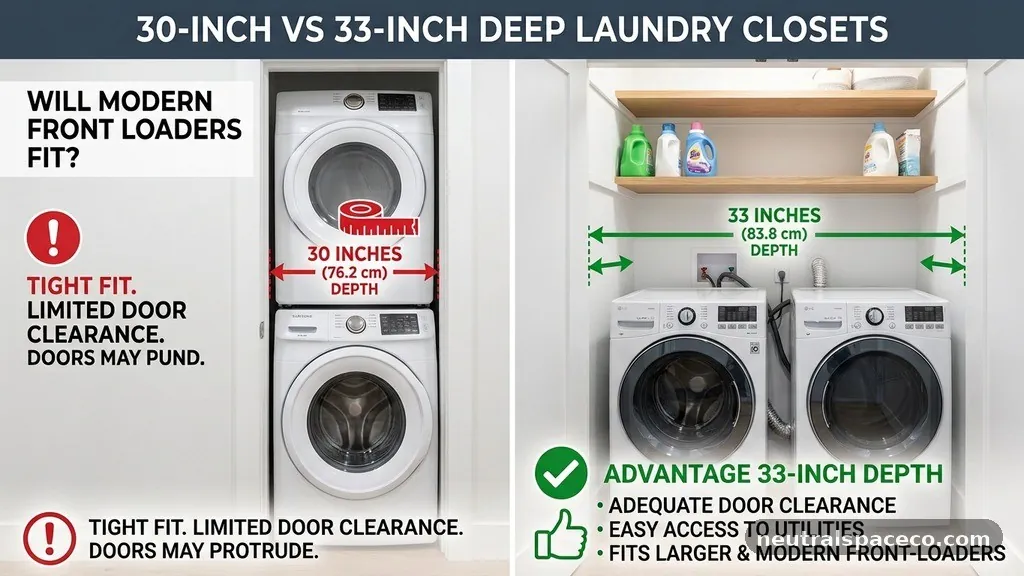
Moving to a 33-inch depth opens up a much wider range of appliance choices. This extra three inches changes the game, allowing you to select standard-sized machines that offer better cleaning performance and faster drying cycles. It is the threshold that separates “specialty” appliances from “mainstream” options.
In a 33-inch space, you can often use low-profile vent kits that save precious room. These specialized kits allow the dryer to sit slightly closer to the wall, which can give you just enough extra clearance to install a slightly larger model than you initially thought possible. This flexibility is invaluable when you want to upgrade your home’s laundry capabilities.
Comparing Appliance Dimensions
To visualize the difference, consider the following table which breaks down the typical space requirements for different laundry configurations. These figures represent the total depth required, including the necessary air gap for hoses and venting.
| Configuration | Typical Depth Needed | Suitability for 30″ Closet |
|---|---|---|
| Compact Stacked Unit | 26–28 inches | Excellent |
| Standard Front Load Pair | 32–34 inches | Poor |
| Extra Capacity Front Load | 34–36 inches | Not Recommended |
| Top Load (Standard) | 28–30 inches | Marginal |
Measuring Your Space Correctly
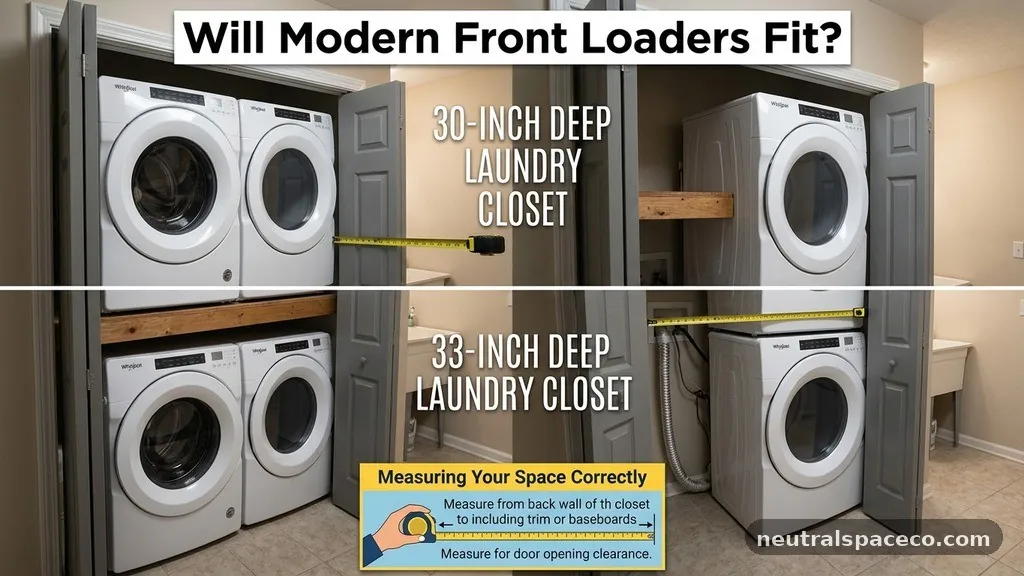
Accuracy is paramount when you are preparing to purchase new appliances. Do not rely on the measurement of the floor alone; you must measure at the level of the plumbing hookups and the electrical outlet. Sometimes, the placement of a valve or a plug can effectively reduce your usable depth by an inch or more.
Use a level to ensure your closet walls are perfectly vertical. If the closet narrows toward the top or bottom, your measurement at the center might be misleading. Always record the smallest measurement you find, as that is the bottleneck that will dictate your maximum machine size.
The Impact of Bi-Fold and Swing Doors
The type of door on your laundry closet also influences how much clearance you need. Bi-fold doors often track inside the closet frame, which can shave off an inch of space if the machines are positioned too far forward. If you have a door that swings outward, you have more flexibility, but you still need to ensure the machine door can open fully without hitting the wall.
Some people choose to remove the closet doors entirely to gain that extra inch of depth. This is a common solution in modern renovations where the laundry area is styled to be part of the living space. If you want to keep your doors, consider replacing bulky bi-fold tracks with barn-style sliding doors to maximize the internal footprint.
Essential Considerations for Installation
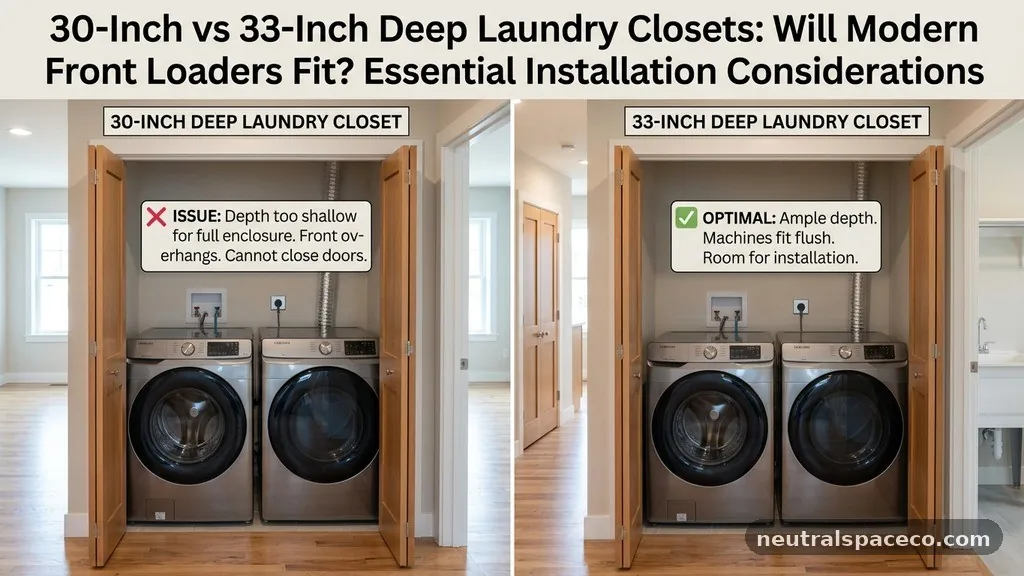
Professional installation is often recommended for front-load machines, especially in tight closets. A technician knows how to use recessed dryer vent boxes and angled hose connectors to shave off critical inches. These accessories are often overlooked by DIY installers but are vital for fitting a large machine into a small space.
For more information on safety and installation standards, you can review the National Fire Protection Association guidelines regarding dryer venting. Proper airflow is not just about performance; it is about preventing lint buildup that can lead to house fires. Never sacrifice ventilation space just to make a machine fit into a closet that is too shallow.
Common Mistakes to Avoid
Many people make the mistake of ignoring the “plug” depth. A standard NEMA 14-30 dryer plug can stick out nearly two inches from the wall outlet. If your machine is pushed flush against that plug, you will never get it deep enough into the closet.
Another mistake is forgetting to account for the door handle. Some front-load washer doors have a significant curve or handle that protrudes forward. If you measure the unit from the back to the front of the cabinet, you will miss the fact that the door adds another two inches of depth to the total footprint.
Frequently Asked Questions
Is a 30-inch deep closet ever enough for a full-size front loader?
It is rarely enough for a standard full-size front loader. You would need to use an ultra-thin, low-profile dryer vent and potentially offset your plumbing valves into the wall cavity to make it work. Most manufacturers strongly advise against this, as it risks damaging the hoses and blocking the dryer exhaust.
What are the best options if my closet is strictly 30 inches deep?
Your best options are compact washer-dryer combos or stackable laundry centers designed for small spaces. These units are specifically built with smaller footprints, often around 24 to 26 inches in depth, which leaves plenty of room for connections and airflow.
How much clearance should be left in front of the machines?
You should ideally have at least 6 to 12 inches of space in front of the machines to allow for comfortable loading and unloading. If you are using a pedestal, you will need even more room to pull out the storage drawer. If the closet door is right against the machine, you will find it very difficult to transfer wet laundry to the dryer.
Can I recess the plumbing to gain more depth?
Yes, moving the water supply box and the electrical outlet into the wall studs can gain you about 1 to 2 inches of depth. This is a common renovation task, but it must be performed by a licensed plumber or electrician to ensure it meets local building codes.
Why do modern machines seem so much deeper than old ones?
Modern machines feature larger, wider drums to accommodate higher laundry capacities. This requires a deeper chassis to house the motor, suspension system, and the drum itself. While they are more efficient and handle larger loads, they are physically larger than the machines common in homes built 20 or 30 years ago.
Final Thoughts on Laundry Closet Planning
When you are deciding between 30-inch vs 33-inch deep laundry closets, honesty about your space is your best asset. If your measurements show a 30-inch depth, fighting to fit a full-sized machine will almost always lead to frustration, potential leaks, or a fire hazard. Opting for a compact unit is a smarter, safer choice that ensures your appliances operate reliably for years.
Conversely, if you have a 33-inch depth or greater, you have the freedom to select high-capacity models that make laundry day much faster. Take your time with the tape measure, account for every hose and cord, and choose the equipment that truly fits your home. Your laundry setup is a long-term investment, so get the numbers right before you make your purchase.