How to Make a Small Bedroom Feel More Functional
A small bedroom does not have to feel like a constant battle between your belongings and the available floor space. The challenge is rarely the size alone. More often, it is the way furniture, storage, lighting, and everyday items interact with the room.
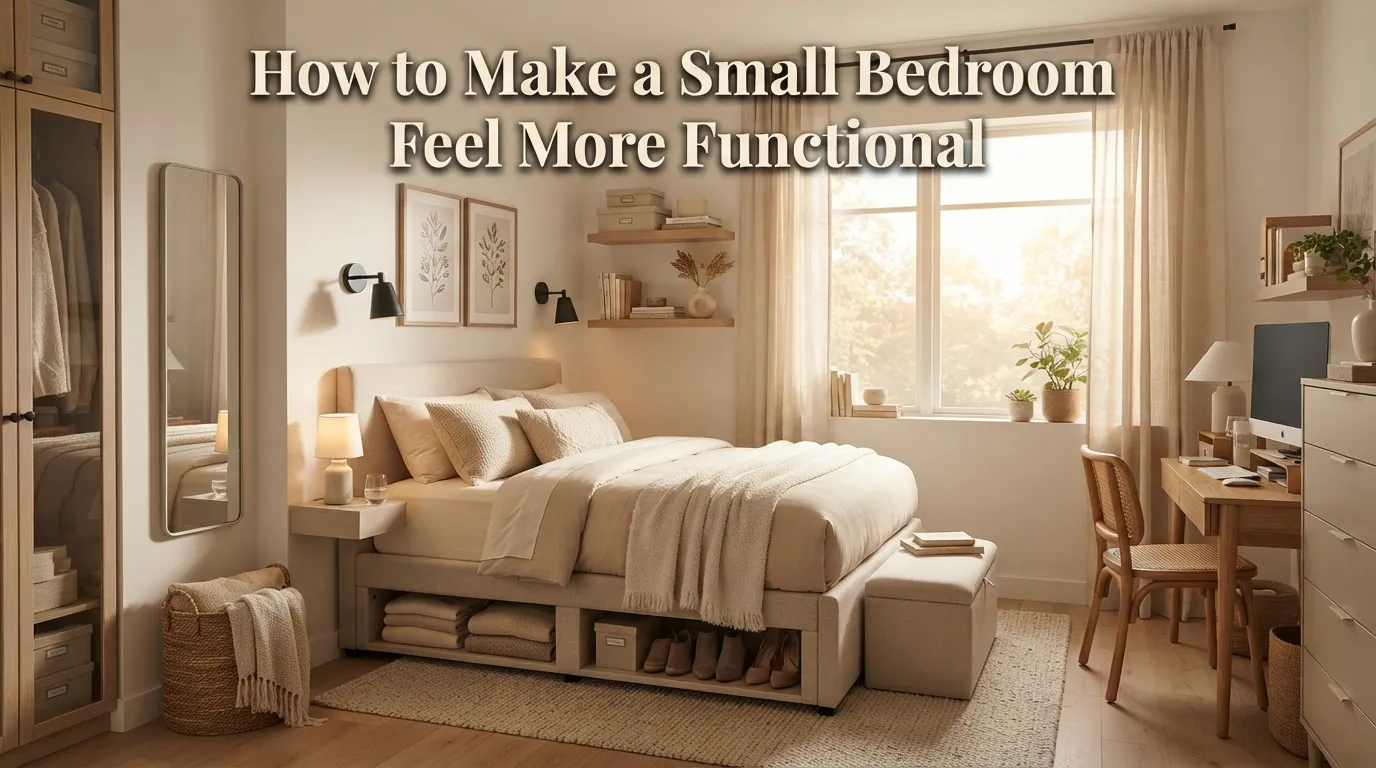
A bedroom can be compact and still feel comfortable, organized, attractive, and surprisingly practical. The trick is to stop thinking about the room as a collection of furniture pieces and start thinking about it as a series of useful zones.
In my experience, the biggest improvement often comes from making one simple change: giving every major activity a defined place. Sleeping needs a comfortable bed and accessible bedside storage. Getting dressed needs an efficient closet or clothing zone. Reading may need a lamp and a small surface. If you work in the bedroom, your workspace needs to be clearly separated from your sleeping area as much as possible.
The good news is that making a small bedroom more functional does not necessarily require remodeling. You can often create a dramatic improvement by changing the furniture arrangement, using vertical space, choosing pieces with multiple purposes, reducing visual clutter, and improving the way frequently used items are stored.
This is particularly useful for apartment bedrooms, guest rooms, children’s-to-adult transition spaces, rental homes, and older homes where bedrooms were not designed around modern storage needs.
The goal is not to squeeze more things into a tiny room. It is to make the room work harder while keeping enough open space for movement and relaxation.
These ideas will help you rethink your bedroom from the floor upward, so the space feels intentional instead of cramped.
Table of Contents
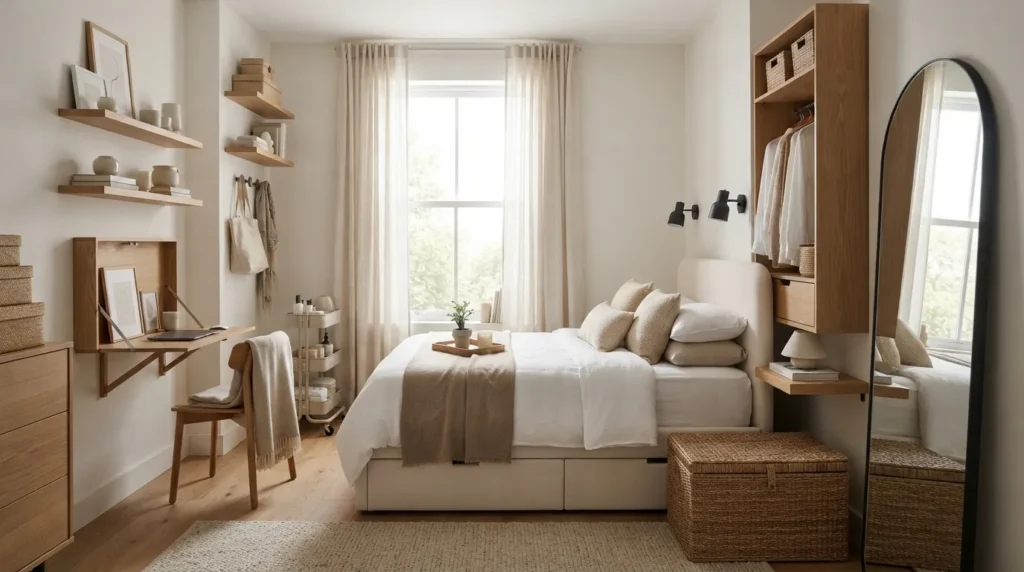
1. Smart Furniture Placement
Create comfortable circulation by arranging large furniture around the room’s natural movement patterns.
2. Multiuse Furniture
Choose pieces that perform two or more jobs without overwhelming the available floor space.
3. Vertical Storage
Use wall height to add practical storage while preserving valuable floor area.
4. Underbed Organization
Turn the unused space beneath the bed into a hidden storage zone for less frequently used belongings.
5. Clear Walking Paths
Protect open floor space so the bedroom remains easy to navigate every day.
6. Functional Bedside Zones
Create compact nightstand areas that support real routines without becoming cluttered.
7. Efficient Closet Systems
Make clothing storage easier to use by editing, grouping, and arranging belongings strategically.
8. Flexible Work Zones
Add a practical workspace when necessary without allowing work equipment to dominate the bedroom.
9. Layered Lighting
Use multiple sources of light to make different parts of the bedroom useful throughout the day.
10. Visual Calm
Combine organization, color, texture, and negative space so the room feels functional and comfortable.
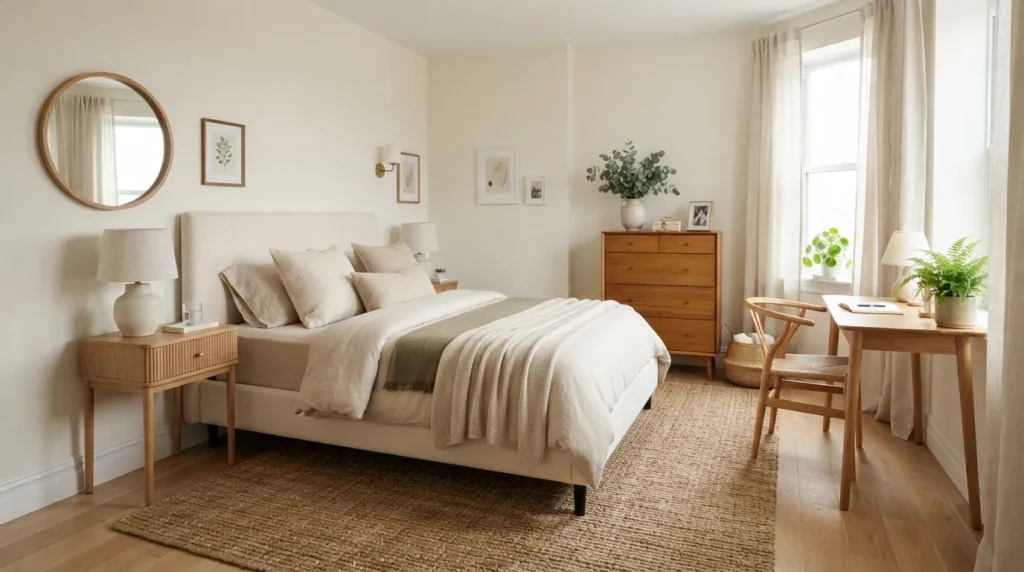
1. Smart Furniture Placement
Quick Benefits
- Improves movement around the room
- Makes existing furniture more useful
- Creates clearer functional zones
- Prevents awkward dead space
- Can transform the room without spending money
Why It Works
Furniture arrangement is often the first place to look when a small bedroom feels dysfunctional. A room can have perfectly reasonable furniture and still feel cramped simply because the pieces are positioned poorly.
The bed usually occupies the largest footprint, so its location determines almost everything else. Once the bed is positioned, look at how people naturally enter, exit, dress, open closets, and move toward windows.
A common mistake is pushing every piece of furniture against a wall without considering how doors and drawers open. That can create narrow bottlenecks and inaccessible storage.
Instead, think about circulation first. A functional bedroom should have a predictable path through it.
You also want to consider sightlines. When entering the room, seeing an organized bed and an open floor area can make the space feel more inviting immediately.
How To Style It
Begin by measuring the room before moving anything.
Mark the location of doors, windows, closets, outlets, radiators, and other fixed features. Then identify the largest piece of furniture, usually the bed.
Place the bed where it allows comfortable access on the sides whenever possible.
Next, position the dresser or wardrobe where drawers and doors can open fully without blocking the walking path.
If your room is especially narrow, consider placing taller furniture along one wall and keeping the opposite side visually lighter.
Avoid creating a maze between the bed, closet, and bedroom door.
If you have a desk, position it near natural light when practical, but make sure the chair does not obstruct the main path.
Before purchasing anything new, experiment with the current furniture. Even moving a dresser a few feet or rotating a bed can make a surprising difference.
A functional layout should make everyday actions feel automatic rather than requiring you to navigate around furniture.
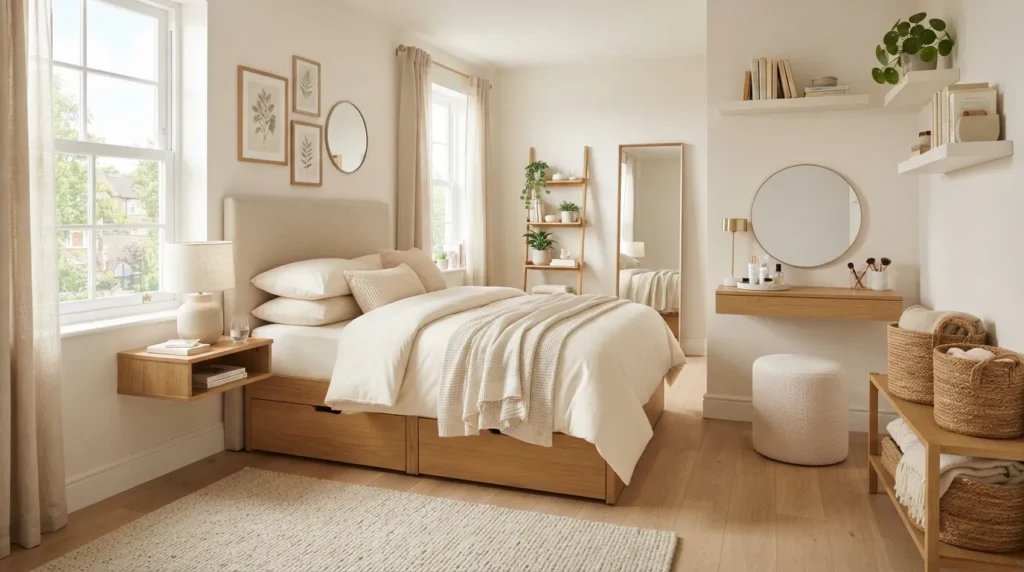
2. Multiuse Furniture
Quick Benefits
- Saves floor space
- Reduces the number of furniture pieces
- Adds storage and functionality
- Makes small rooms more flexible
- Supports multiple activities
Why It Works
When space is limited, furniture needs to do more than one job whenever possible.
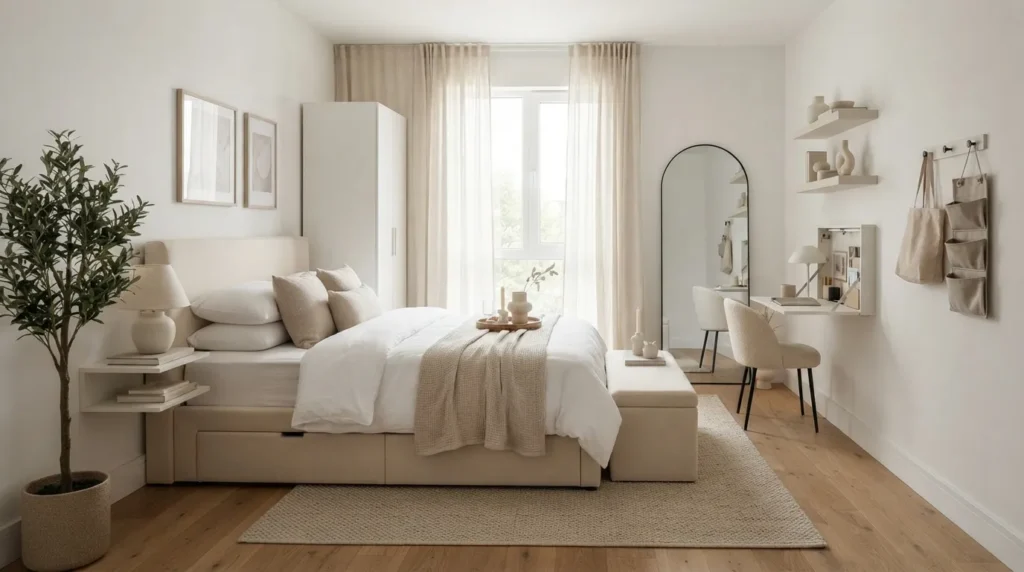
A storage ottoman can provide seating and hold blankets. A dresser can double as a media console or vanity. A desk can function as both a workspace and getting-ready station. A bed with drawers can replace an additional storage cabinet.
This approach is especially useful because it reduces the number of separate objects occupying the room.
However, multifunctional furniture should solve a genuine problem. There is no benefit to buying a complicated piece with five functions if you only use one or two of them.
The most successful pieces are usually simple. They perform multiple jobs naturally without making the room feel like a storage unit.
How To Style It
Start by listing what actually happens in your bedroom.
Do you get dressed there?
Read?
Work?
Exercise?
Store linens?
Keep shoes?
Do children or pets use the room?
Once you understand the activities, look for furniture that supports more than one.
For example, a compact desk with drawers can function as a workspace and beauty station. A storage bench at the foot of the bed can provide seating while holding extra blankets.
If you have enough room for a dresser, choose one with substantial drawers instead of adding several smaller storage units.
In a very small room, a narrow console may provide enough surface space without creating the bulk of a traditional desk.
Keep the furniture visually simple. Clean-lined silhouettes, neutral finishes, and hidden storage tend to make multifunctional pieces feel less visually heavy.
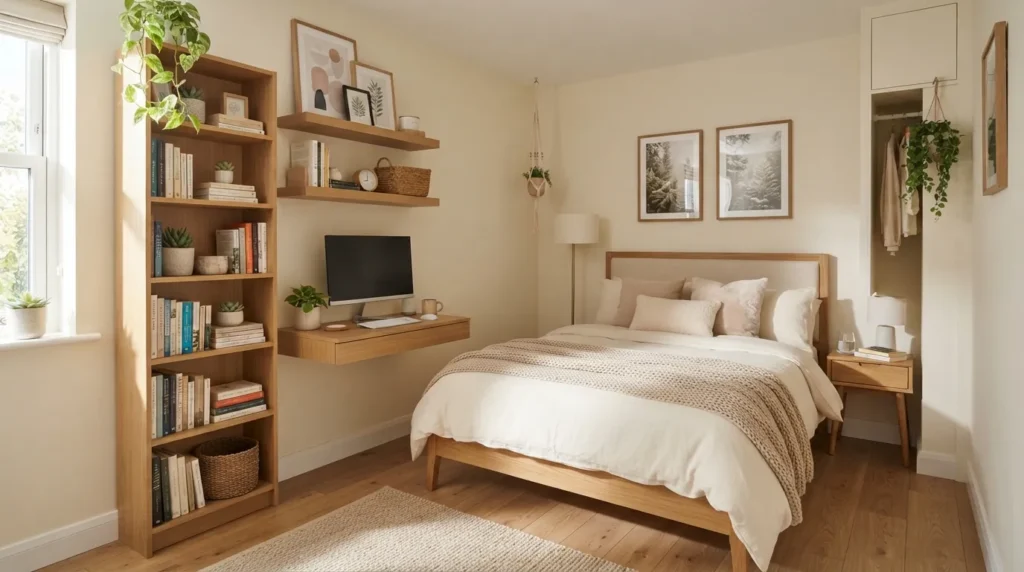
3. Vertical Storage
Quick Benefits
- Uses overlooked wall space
- Preserves floor area
- Adds storage capacity
- Helps organize everyday items
- Can make the room feel taller
Why It Works
When floor space is scarce, walls become valuable real estate.
Many small bedrooms have unused areas above dressers, desks, nightstands, or doorways. Using that height can provide storage without adding another piece of furniture to the floor.
Vertical storage is especially useful for books, accessories, decorative objects, small baskets, and items that do not need to remain within immediate reach.
The visual effect matters, too. Tall and narrow storage can emphasize the height of a room rather than its limited width.
However, too much open shelving can create visual clutter. The goal is not to use every available inch of wall. It is to choose the areas that will provide the greatest practical benefit.
How To Style It
Look for narrow wall sections that are currently doing nothing.
A floating shelf above a desk can hold books and office supplies. A shelf above a dresser can display a few decorative objects while keeping the dresser surface clear.
Wall hooks are useful for bags, hats, robes, and frequently worn accessories.
A tall bookcase can be more efficient than a wide low cabinet when floor space is limited.
For renters, consider freestanding vertical storage or appropriately rated removable solutions where suitable.
If you use open shelves, combine practical and decorative objects. A basket can conceal small items while books and artwork provide visual interest.
Leave some empty space between groups of objects.
A shelf that contains ten carefully selected items usually feels more functional and attractive than one packed from edge to edge.
Always make sure wall-mounted storage is installed securely and used within the manufacturer’s weight limits.
4. Underbed Organization
Quick Benefits
- Uses otherwise wasted space
- Frees closet capacity
- Keeps seasonal items hidden
- Works without renovation
- Helps maintain a cleaner room
Why It Works
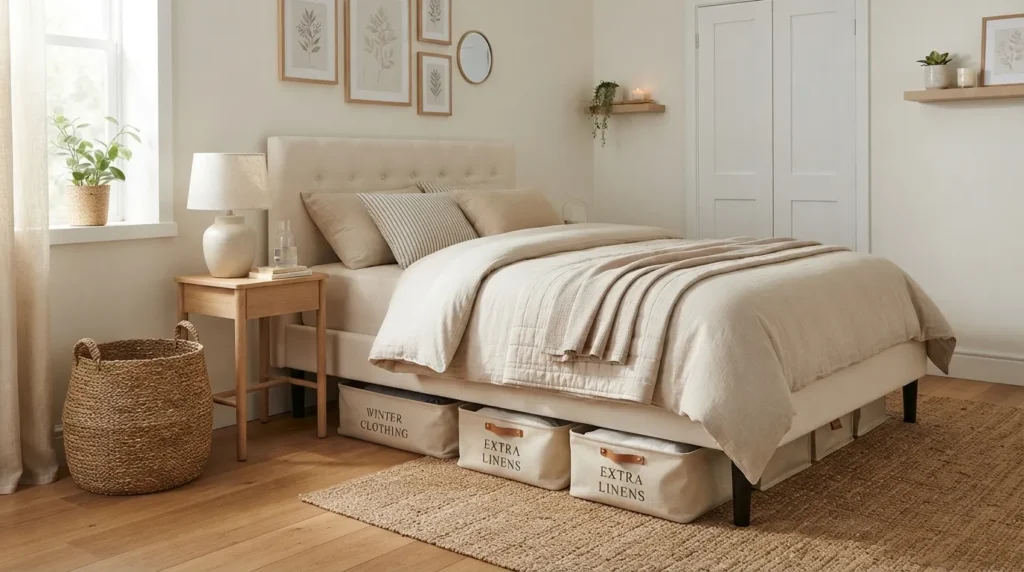
The space beneath a bed is often one of the largest unused storage areas in a small bedroom.
Instead of letting that space become a random collection of boxes and forgotten belongings, turn it into a deliberate storage zone.
Under-bed storage works particularly well for things you do not need every day. Seasonal clothing, spare bedding, shoes, luggage, and keepsakes can often be stored there when appropriate.
The key is accessibility. If containers are difficult to remove, you will eventually stop using the system.
It is also important to consider the environment underneath the bed. Items that are sensitive to moisture, dust, or poor ventilation should be stored appropriately rather than automatically placed underneath.
How To Style It
First, completely clear the space beneath the bed.
Sort everything into categories.
Try categories such as:
- Winter clothing
- Extra bedding
- Shoes
- Travel items
- Seasonal accessories
- Keepsakes
Use shallow containers that match the available clearance.
Containers with handles or wheels can make access easier.
Clear bins are useful when you need to identify contents quickly, while fabric storage boxes can create a softer appearance.
Labels are particularly helpful. Write the category on the front or side so you do not have to remove several containers to find what you need.
Avoid creating one giant miscellaneous storage area.
If an item does not belong to a clear category, decide whether it actually needs to remain in the bedroom.
A well-organized under-bed system should feel like an extension of your closet rather than a hidden junk drawer.
5. Clear Walking Paths
Quick Benefits
- Makes the room easier to navigate
- Improves everyday comfort
- Makes the space feel larger
- Prevents furniture from feeling overwhelming
- Simplifies cleaning
Why It Works
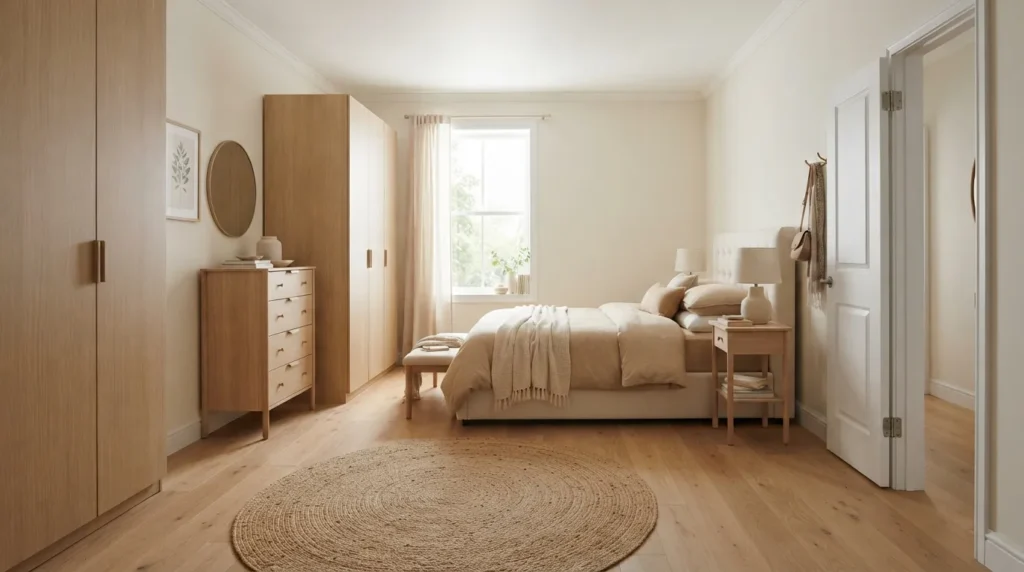
Open floor space is one of the most important features of a functional small bedroom.
When furniture blocks the natural walking route, even a relatively spacious room can feel cramped. You may find yourself walking sideways around the bed, squeezing between furniture, or moving objects every time you open a closet.
Protecting circulation solves these problems.
A functional bedroom does not necessarily need a large empty center. It simply needs enough room for the activities you perform every day.
Think about the route from the bedroom door to the bed, closet, bathroom, and dresser.
Those pathways should remain as clear as possible.
How To Style It
Walk through your bedroom as if you were seeing it for the first time.
Enter through the door.
Walk to the closet.
Open the closet.
Move toward the bed.
Sit down.
Open the dresser drawers.
Notice where your body naturally moves.
Any piece of furniture that repeatedly interrupts those movements deserves reconsideration.
If a chair is constantly blocking a closet door, move it.
If a storage basket sits in the middle of the walkway, relocate it.
If a dresser drawer cannot open fully because it hits the bed, change the arrangement.
Use rugs carefully. In a small room, an oversized rug can visually connect the furniture, but a poorly positioned rug can also interfere with movement.
The goal is a bedroom where you can perform your routine without constantly navigating around obstacles.
6. Functional Bedside Zones
Quick Benefits
- Keeps daily essentials accessible
- Reduces bedside clutter
- Supports bedtime routines
- Makes cleaning easier
- Creates visual balance
Why It Works
The bedside area is small, but it performs several important jobs.
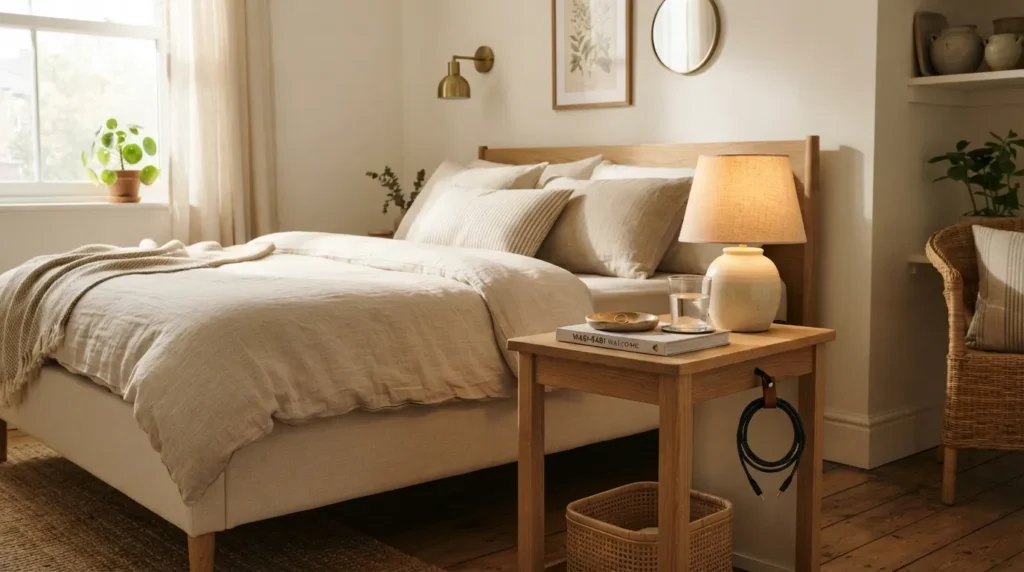
It holds lighting, books, phones, glasses, water, chargers, and other personal essentials.
Because so many items naturally accumulate there, the nightstand can quickly become one of the messiest surfaces in the bedroom.
The solution is to design the nightstand around your actual routine.
If you read every night, make room for books.
If you charge devices beside the bed, create a designated charging location.
If you wear glasses, give them a consistent home.
Functional design means the things you use most should be the easiest things to put away.
How To Style It
Choose a nightstand that fits the available space rather than automatically buying a standard-sized table.
A narrow drawer unit may provide more practical storage than a larger open table.
Use one small tray for loose objects.
Place a lamp or appropriately installed wall light within comfortable reach.
Keep only your current book or reading material visible.
If you need charging cables, use a simple cable-management solution so they do not become tangled across the surface.
The top of the nightstand should have breathing room.
For a balanced appearance, repeat one or two elements from the opposite side of the bed, such as the lamp finish or wood tone, while allowing the furniture itself to differ if necessary.
A small bedside zone can be both attractive and highly functional when every object has a reason to be there.
7. Efficient Closet Systems
Quick Benefits
- Makes clothing easier to find
- Creates more usable capacity
- Reduces wardrobe clutter
- Speeds up daily routines
- Helps prevent clothing piles
Why It Works
A small bedroom often feels dysfunctional because the closet is dysfunctional.
When clothing is packed too tightly, drawers are overflowing, and shoes are scattered across the floor, the bedroom quickly becomes a storage overflow area.
The first step is not necessarily buying closet organizers.
It is editing.
You need enough space around your belongings to see and access what you own.
Once unnecessary items are removed, simple organizational improvements can dramatically increase usability.
How To Style It
Begin with clothing you no longer wear.
Remove damaged items, uncomfortable pieces, duplicates, and belongings that no longer suit your lifestyle.
Then group the remaining wardrobe.
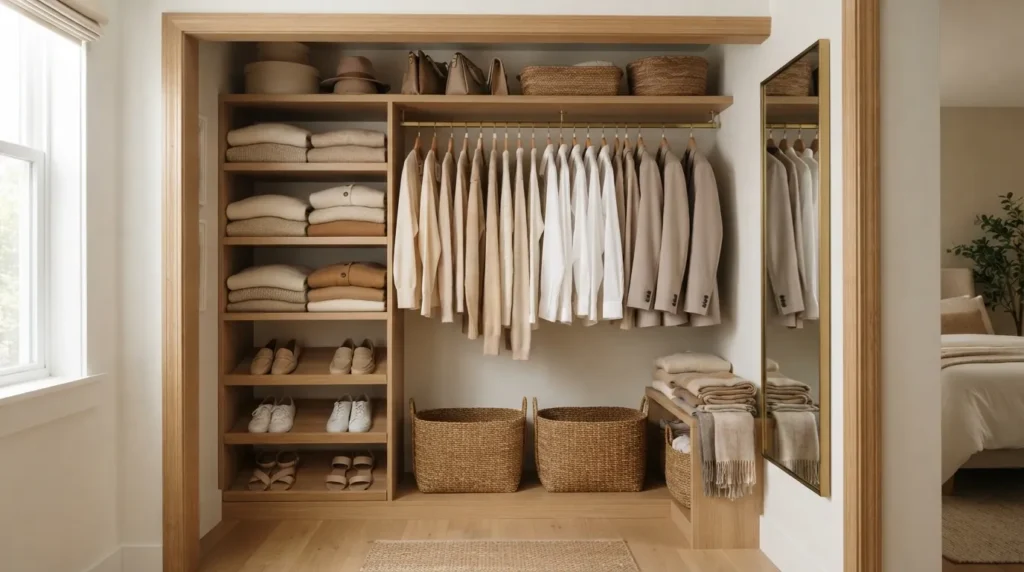
You can organize by clothing type, color, season, or frequency of use.
Keep the system intuitive.
Everyday pieces should be easiest to reach.
Less frequently used seasonal clothing can go toward the back, upper shelves, or appropriate under-bed storage.
Use drawer dividers for small accessories if they genuinely help.
Slim hangers can create additional hanging capacity, but do not use them as an excuse to keep an excessive wardrobe.
Shoes should have a defined location.
If your closet is too small for all your clothing, rotate seasonal pieces rather than forcing everything into the same space.
An efficient closet should make getting dressed easier, not turn the morning into a search expedition.
8. Flexible Work Zones
Quick Benefits
- Allows the bedroom to support multiple activities
- Creates a defined workspace
- Reduces visual work clutter
- Works well in apartments
- Makes better use of limited space
Why It Works
Many adults now use bedrooms for more than sleeping.
You might answer emails from a small desk, pay bills, work remotely, get ready for the day, or pursue a creative hobby.
The problem is that work equipment can quickly make a bedroom feel less restful.
The solution is to create a clearly defined zone rather than allowing work items to spread across the room.
Even a tiny workspace can function well when the furniture is appropriately scaled and storage is carefully planned.
How To Style It
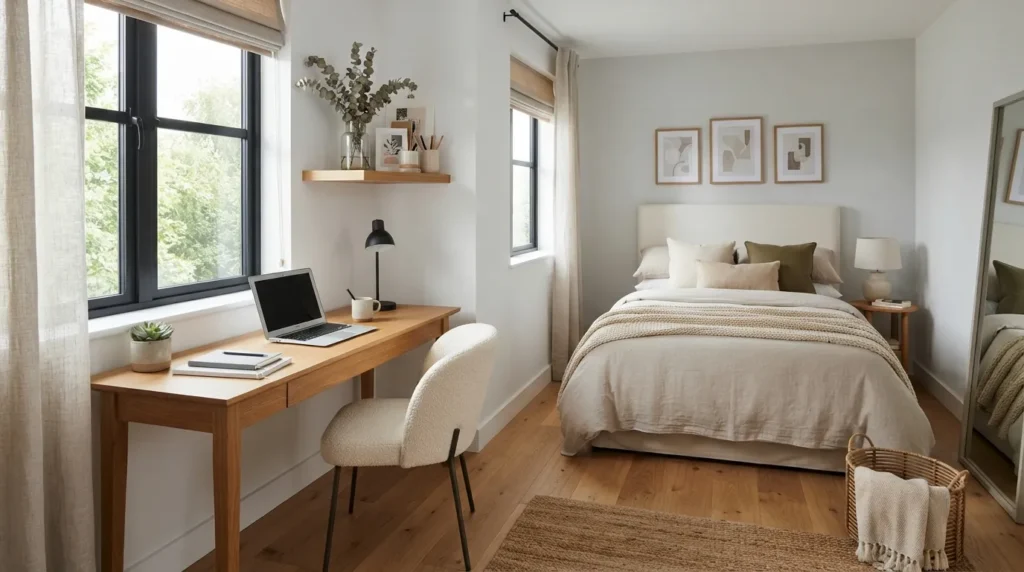
A narrow desk can often fit along a wall without dominating the room.
Choose a design with drawers if you need to store notebooks, chargers, or office supplies.
If possible, position the desk near natural light.
Keep the chair proportional to the desk and make sure it can slide underneath when not being used.
Use vertical storage above the desk for papers and supplies.
At the end of the workday, clear the surface.
A small basket or drawer can hold work-related items so they can be visually removed from the sleeping area.
If space is extremely limited, consider a wall-mounted drop-leaf desk or another compact solution suitable for your room and installation circumstances.
The objective is flexibility: work when necessary, then allow the bedroom to return to being a restful space.
9. Layered Lighting
Quick Benefits
- Makes different zones more useful
- Improves nighttime comfort
- Adds warmth
- Reduces dependence on overhead lighting
- Creates visual depth
Why It Works
A small bedroom can feel surprisingly different depending on how it is illuminated.
One bright ceiling fixture may provide enough general visibility, but it does not necessarily create a comfortable atmosphere for reading, getting dressed, relaxing, or winding down.
Layered lighting solves this by giving the room several levels of illumination.
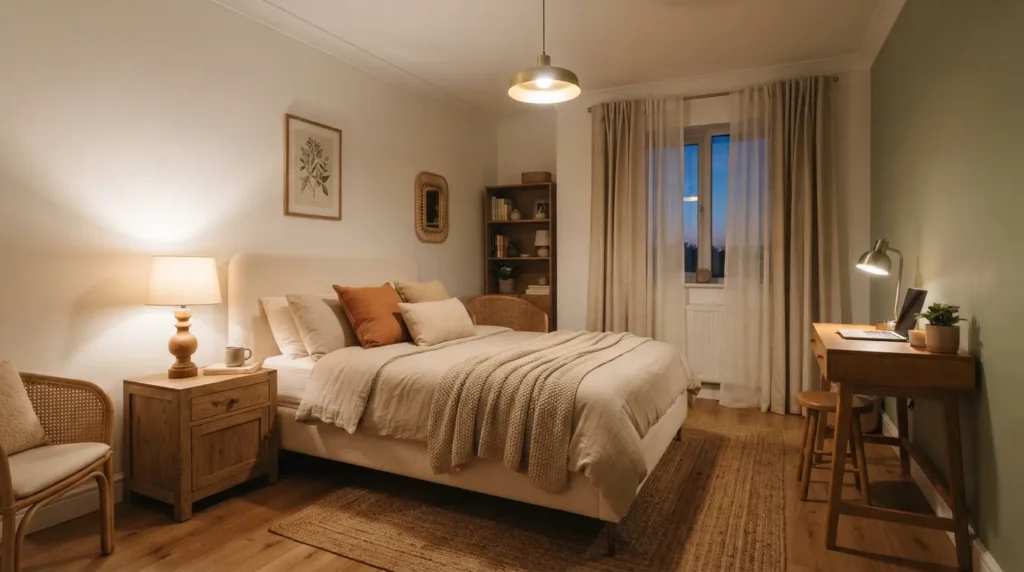
Ambient lighting provides general brightness.
Task lighting helps with specific activities.
Accent lighting adds atmosphere.
This approach is especially useful in small bedrooms because the right lighting can make the space feel intentional without requiring additional furniture.
How To Style It
Start with the main ceiling fixture.
Choose something proportionate to the room rather than an oversized statement piece that visually dominates the space.
Add bedside lighting.
Table lamps work well when nightstand space permits. Wall-mounted fixtures can preserve surface area when appropriate and safely installed.
A desk should have dedicated task lighting if you regularly work there.
Consider a floor lamp only if it does not interfere with your walking path.
Use warm, comfortable lighting in the evening where appropriate.
Dimmers are useful when compatible with the fixtures and electrical setup.
Also maximize natural light during the day. Keep windows relatively unobstructed and use curtains or shades that allow you to control privacy and brightness.
A small bedroom benefits from lighting that can change with the activity.
10. Visual Calm
Quick Benefits
- Makes the room feel less crowded
- Improves the appearance of organization
- Creates a relaxing atmosphere
- Makes furniture feel lighter
- Helps the room feel more intentional
Why It Works
Functionality is not only about storage and furniture.
A bedroom can technically have a place for everything and still feel overwhelming if every surface is visually busy.
Visual calm comes from reducing unnecessary information.
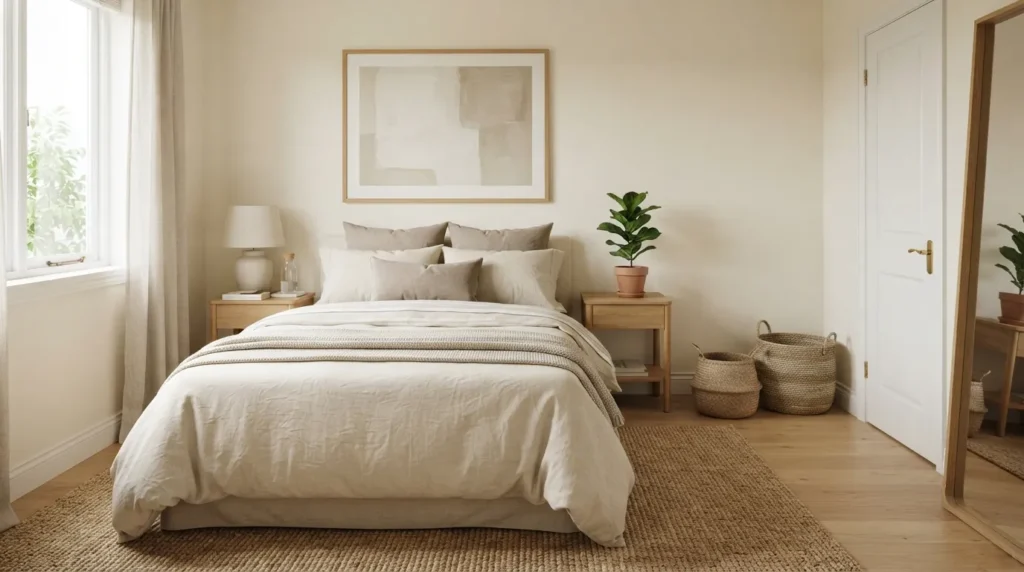
A limited color palette, coordinated materials, clear surfaces, and open floor area can make a small bedroom feel significantly more comfortable.
This does not mean the room has to be minimalist or boring.
You can still use artwork, plants, books, patterned bedding, and decorative objects.
The difference is that those elements should work together instead of competing for attention.
One simple trick I always suggest is to step back from the room and identify the first three things your eye notices.
If all three are cluttered areas, the room probably needs editing.
How To Style It
Choose a simple base palette.
Warm white, cream, beige, soft gray, muted green, and natural wood are versatile options.
Then select one or two accent colors.
Repeat materials throughout the room to create cohesion.
For example, if you have warm oak furniture, repeat that wood tone in a picture frame or small tray.
Keep dresser and nightstand surfaces relatively clear.
Use baskets or closed storage for small miscellaneous belongings.
Avoid decorating every wall.
One large artwork piece can often create more impact than several tiny pieces.
Keep the floor as open as possible.
Finally, make the bed every morning. It sounds simple, but the bed occupies such a large percentage of the room that a neatly made bed can immediately make the entire space look more organized.
How To Make A Small Bedroom More Functional Without Renovating
You do not need to start with construction.
In fact, the most effective changes are often inexpensive or completely free.
Start With A Measurement
Measure the room, furniture, and major walking paths.
Knowing your actual dimensions prevents expensive mistakes.
Remove What You Do Not Need
Decluttering creates functional space before you buy anything.
Rearrange First
Try several furniture layouts.
Take photos from the doorway so you can compare them objectively.
Use Existing Storage
Look under the bed, inside the closet, behind the door, and above furniture.
Add Vertical Solutions
Use appropriate shelves, hooks, or freestanding tall storage where practical.
Simplify Surfaces
Reduce the number of objects on dressers, desks, and nightstands.
Create Activity Zones
Give sleeping, dressing, working, and relaxing their own visual areas.
Choose Dual-Purpose Pieces
When something needs replacing, look for furniture that solves more than one problem.
The best no-renovation bedroom transformations usually happen through a combination of small changes rather than one expensive purchase.
Small Bedroom Furniture Layout Tips
Furniture size matters just as much as furniture quantity.
A large bed may be non-negotiable, but other pieces can often be scaled down.
Consider a narrow nightstand instead of a wide bedside table.
Choose a tall dresser instead of a very wide one when floor space is limited.
Use a slim desk instead of a full-size workstation.
Replace a bulky accent chair with a compact stool if seating is necessary.
Avoid placing tall furniture directly beside windows when it blocks natural light.
When possible, create symmetry around the bed, but do not sacrifice functionality simply to make both sides identical.
If one side of the room is significantly narrower, an asymmetrical arrangement can work beautifully.
The best layout is the one that makes everyday movement easiest.
Small Bedroom Storage Zones
One of the easiest ways to make a bedroom more functional is to assign storage by category.
Clothing Zone
Closet, dresser, clothing rack, or under-bed storage.
Bedside Zone
Books, glasses, charging accessories, and nighttime essentials.
Entry Zone
Shoes, bags, keys, and frequently used outerwear.
Work Zone
Laptop, papers, office supplies, and chargers.
Seasonal Zone
Winter bedding, seasonal clothing, luggage, and holiday accessories.
When every category has a defined home, clutter becomes much easier to prevent.
FAQ
How can I make a small bedroom more functional?
Start by improving the layout, clearing walking paths, reducing unnecessary belongings, and using storage efficiently. Prioritize furniture that serves multiple purposes and use vertical and under-bed areas for additional storage. The goal is to make everyday activities—sleeping, dressing, working, and relaxing—easy to perform without constantly moving furniture or belongings.
What furniture is best for a small bedroom?
Furniture with a compact footprint and more than one function tends to work well. Consider beds with drawers, narrow nightstands, tall dressers, compact desks, storage ottomans, and slim shelving. Always measure the room first and account for doors, drawers, and walking paths rather than looking only at the furniture’s closed dimensions.
How do I make a small bedroom feel less cramped?
Keep walking paths open, reduce visual clutter, use appropriately scaled furniture, and avoid filling every wall or corner. Light colors, coordinated materials, natural light, mirrors, and layered lighting can also help create a more open feeling. The key is balancing necessary furniture with enough negative space.
How do I add storage without making a bedroom feel crowded?
Use hidden and vertical storage first. Under-bed containers, closet organization, wall shelves, over-door organizers, and tall narrow furniture can add capacity without consuming much additional floor space. Choose coordinated storage materials and avoid leaving too many small objects visible.
Should I put a desk in a small bedroom?
A desk can work well if you genuinely need a workspace, but it should be appropriately scaled. Choose a narrow desk, compact chair, or multifunctional piece when possible. Keep work supplies contained and clear the surface at the end of the day so the bedroom can return to feeling like a restful space.
What should I remove from a small bedroom?
Start with belongings you no longer use, damaged clothing, duplicate items, old paperwork, unnecessary decor, and anything that belongs elsewhere. Then look at furniture that rarely serves a purpose. In a small room, every object should either support your routine, provide useful storage, or contribute something you genuinely value.
How can I make a small bedroom functional on a budget?
Begin with free changes: declutter, rearrange furniture, organize drawers, clear surfaces, and use existing under-bed or closet space. Then consider inexpensive additions such as baskets, drawer dividers, hooks, or simple organizers. You do not need a complete furniture makeover to make a small bedroom significantly more practical.
Conclusion
Making a small bedroom more functional is really about making intentional decisions.
You do not need a larger room. You need a layout that supports the way you actually live.
Start with furniture placement and walking paths. Make sure the bed, dresser, closet, and other major pieces do not interfere with one another. Then look for opportunities to make individual pieces work harder through multifunctional furniture and hidden storage.
Use vertical space instead of automatically adding more floor furniture. Reclaim the area beneath the bed. Give your closet a system that makes getting dressed easier. Create a small but practical bedside zone, and if you work from your bedroom, give that activity a defined home.
Then look at the visual side.
A functional bedroom should still feel comfortable. Layer warm lighting, use a restrained palette, introduce natural textures, and keep surfaces edited. Leave enough open space for the room to breathe.
Most importantly, do not try to solve every problem at once.
Choose the one area that causes the most frustration. Maybe your closet is overflowing. Maybe the bed blocks the walking path. Maybe your nightstand is always cluttered.
Fix that one problem first.
Once the room becomes easier to use, the next improvement becomes much more obvious.
A small bedroom can be practical, beautiful, and comfortable at the same time. With thoughtful layout choices, smart storage, and a little visual restraint, even a compact room can become a space that supports your everyday life instead of getting in its way.
Related Articles
- 10 Small Bedroom Organization Ideas Without Renovating
- 10 Modern Bedroom Ideas That Feel Luxurious
- 11 Small Bedroom Storage Ideas for More Space
- 10 Cozy Bedroom Ideas for a Relaxing Retreat
- 10 Modern Aesthetic Bedroom Ideas for Adults